


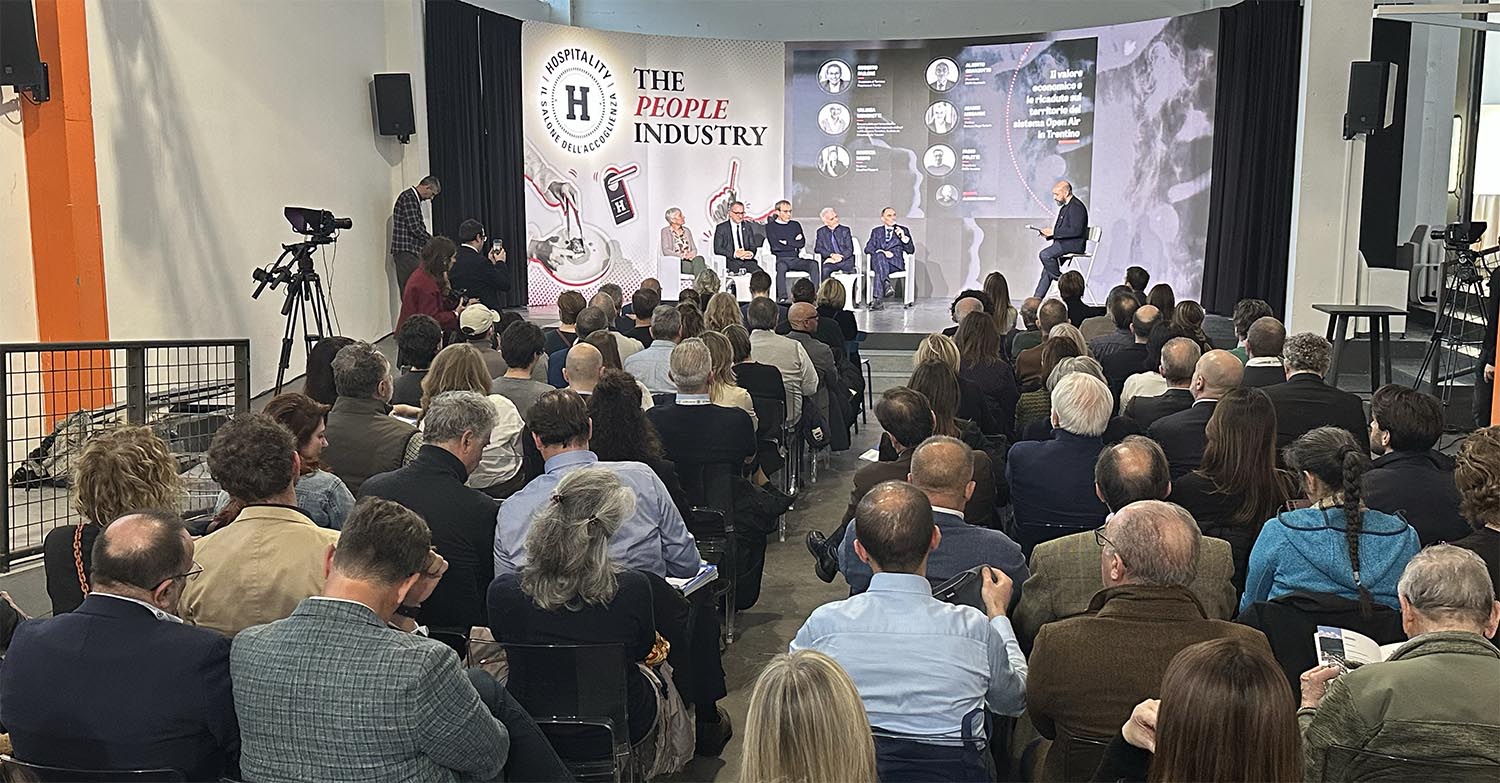
Hospitality – Il Salone dell’Accoglienza in Riva del Garda hosted the conference “The economic value and territorial impact of the open-air system in Trentino“, organized by FAITA Trentino. The event brought together industry representatives and local administrators to analyze data and prospects for the Autonomous Province, where open-air tourism is thriving.

Valeria Minghetti, Head of Research at CISET, summarized national data for 2024, highlighting a slight stagnation in the sector (-0.7% in revenue, -0.5% in foreign arrivals and overnight stays, -2.6% in domestic arrivals, and -3.0% in domestic overnight stays), despite a 2.4% increase in average accommodation rates. Performance varied by geographical area, with the Northeast standing out with a +2.4% revenue increase and a 3.2% rise in rates. The best results were recorded in mountain areas, while lakes suffered slightly.
In Trentino, open-air tourism recorded 429,000 arrivals and over 3.2 million overnight stays, representing more than 10% of the province’s tourism movement. This marks a 1.6% increase in overnight stays and a 0.4% increase in arrivals. Foreign visitors make up 65% of the market. Compared to 2019, arrivals and overnight stays have grown by 16.7% and 14.6%, respectively. The 71 facilities in the area account for 20% of available beds.
The economic value of open-air tourism

FAITA-FederCamping President Alberto Granzotto highlighted the findings of a study commissioned by FAITA Trentino: “Considering a sample of 20% of Trentino’s open-air accommodation facilities, the booking curve from March 22 to October 31, 2024, exceeded the market average. The average vacation duration remains stable, with an increase in average prices across all accommodation types“. The primary markets are Germany, Italy, the Netherlands, Austria, and Poland, with a slight decline among Italian visitors. In terms of bookings already acquired, about 50% of total 2024 reservations have been secured, with the average revenue still rising. The German market is responding positively, especially given the economic context in Germany.

“The data is important because it shows both the work done and the trends for 2025,” stated Roberto Failoni, Provincial Councillor for Handicrafts, Commerce, Tourism, Forests, Hunting, and Fishing of the Autonomous Province of Trento. “Years ago, we looked at bread and gasoline prices to understand trends; today, we have HBenchmark. We are in a very positive phase. In Trentino, there is growing awareness of the importance of open-air tourism, which is now positively recognized by other tourism sectors. We are working as a system, despite urban planning slowdowns, and we are implementing investments. However, more information efforts are needed, as tourism is publicly under attack. We need to highlight the revenue it generates and its social impact. The Trentino economy would face significant challenges without tourism“.
Valeria Minghetti then presented a detailed economic analysis: open-air tourism in Trentino generates approximately €200 million in total expenditure, divided into 32% for accommodation and 68% for other local expenses. Those who choose to stay in accommodations spend 52% of their budget in the region, while those traveling by camper or caravan leave 80% of their expenditure locally. Essentially, for every euro spent on accommodation, those staying in structured lodgings contribute €1.1 to the local economy, while camper or caravan travelers contribute €2.79.
Challenges for the future: investments and urban planning

FAITA Trentino President Fabio Poletti emphasized the importance of in-depth studies to guide strategic sector decisions: “If we want to continue being leaders, we must invest more in quality. Today, services make the difference. However, we need urban planning tools. We live in a highly conscientious territory, but some municipalities are not willing to seize opportunities. Today, having a campsite in one’s area is an asset, not a problem“.
Provincial Tourism Councillor Roberto Failoni highlighted the need to address these issues at an institutional level: “We have 166 municipalities, each with its own mayor, viewing things differently. We need to find shared solutions, recognizing open-air tourism as a strategic asset for Trentino’s economy“.
Gianni Morandi, Mayor of Nago-Torbole, emphasized the social and ecological benefits of open-air tourism: “The entire coastal strip of the lake is occupied by campsites, which has helped maintain green spaces and preserve the environment”. This theme was echoed by Roberta Nesto, Mayor of Cavallino-Treporti, who reiterated the need for a balance between tourism development and environmental protection.
Outlook for 2025
The presented data outlines a positive trend for 2025, with the sector becoming increasingly integrated into Trentino’s economic and social fabric. However, open-air tourism growth must be supported by appropriate urban policiesand greater awareness of its economic and social impact. Open-air tourism is not only an economic opportunity but also a sustainable model for regional development.


Camping Village Roma Capitol: a new water park and excellent prospects for the season