

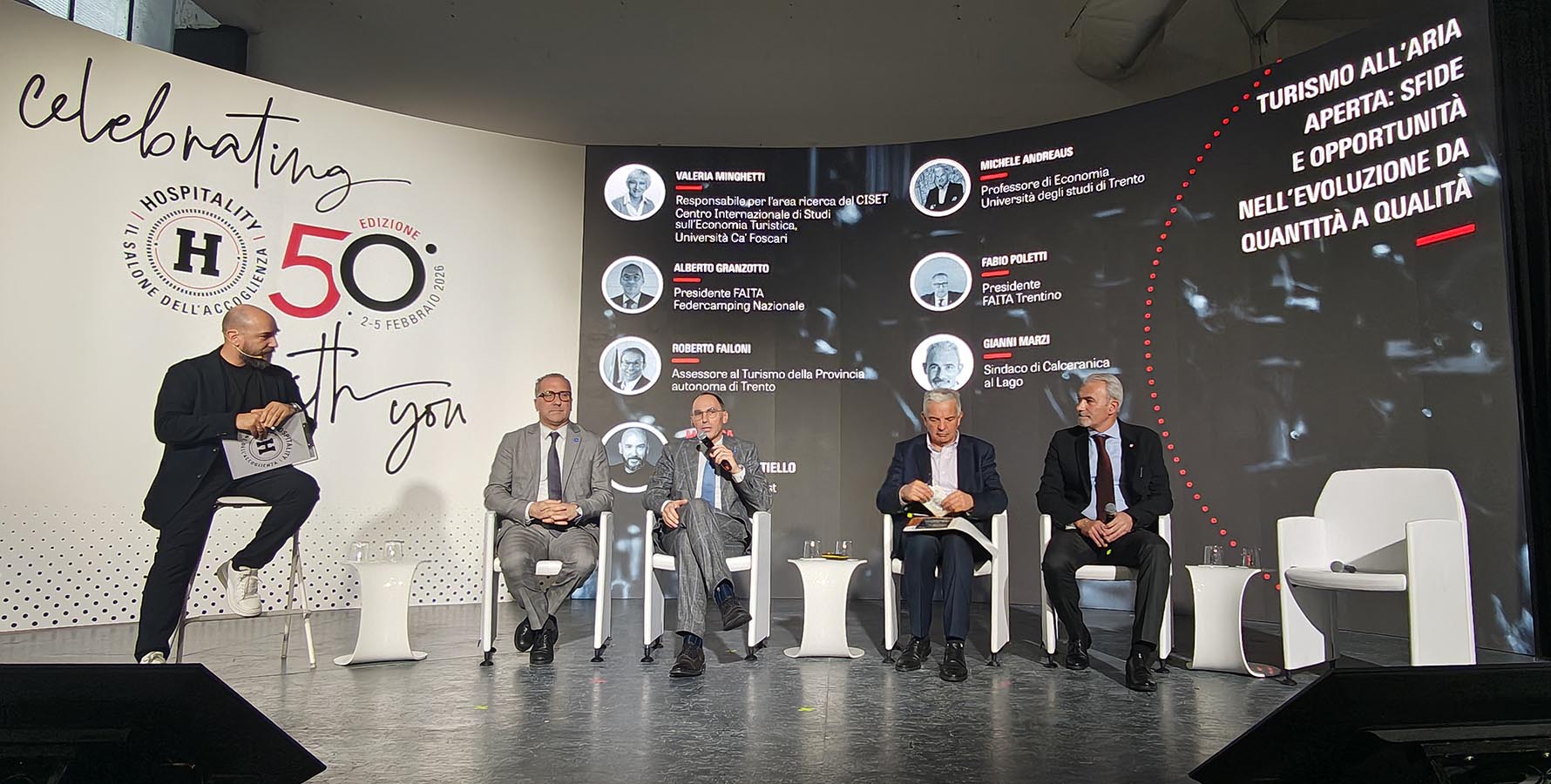

The open-air tourism sector in Trentino is undergoing a profound strategic transformation, evolving from what was once perceived as a “second-tier product” into a cornerstone of the region’s tourism economy. Speaking at the conference “Open-air tourism: challenges and opportunities in the shift from volume to value”, held during Hospitality – Il Salone dell’Accoglienza, Alberto Granzotto, President of FAITA Federcamping, opened proceedings by highlighting the vitality of a sector that continues to grow and invest at pace.
Granzotto explained how the industry has changed dramatically, following a trend that was significantly accelerated in the post-Covid period, turning open-air holidays into a model of qualitative excellence built on a close relationship with the territory and a strong focus on sustainability. He firmly reiterated that “this holiday philosophy is inherently linked to nature and therefore to sustainability”, elements that are no longer optional but now sit at the heart of ESG priorities for every entrepreneur in the sector.
Financial strength that fuels continuous investment
From an economic perspective, data presented by Valeria Minghetti of CISET revealed remarkable efficiency. Although Trentino accounts for just 2.8% of the total number of campsites nationwide, it generates 6.6% of the Italian open-air sector’s overall EBITDA. This level of profitability is more than double its share of turnover (3.2%), even outperforming Veneto, where EBITDA represents 39.8% against a revenue share of 31.4%.

This financial robustness enables Trentino-based businesses to invest consistently in quality. “We interpret quality in many different ways on a daily basis: through continuous upgrades to the physical infrastructure of campsites, meticulous landscape and green-area management, and the development of increasingly premium services such as private bathrooms, while also responding to new customer needs linked to sport, safety and accessibility,” Granzotto explained. In addition, guests staying in campsites and holiday parks tend to remain longer, encouraging a form of “slow tourism” that allows for deeper territorial discovery and reduced seasonality.
A technical survey conducted across 71 companies highlighted a predominantly in-house operational model, with 63% of services managed internally, but also pointed to room for improvement in digital development. Although 80% of businesses have invested in IT upgrades over the past decade, digital maturity remains uneven: only 30% operate genuine e-commerce systems, while 37.5% still rely on a purely showcase-style website.
Revenue is still generated primarily through direct sales (61.1%) and company websites (28.8%). Meanwhile, specialist portals and general travel platforms, while often used for visibility, continue to play a marginal role in actual bookings – accounting for just 1.8% and 2.4% respectively. A key future challenge will be gaining a clearer understanding of ROI across these channels, which are frequently treated as free marketing tools rather than measurable sales drivers.
Looking ahead to 2030: possible development scenarios
The report outlines three potential growth models towards 2030: the “Pioneers”, the “Followers” and the “Inertia-driven” businesses. The Pioneers – around 15% of the total – have diversified accommodation types and fully digitalised their offer, attracting new customers equal to half of their total clientele. The Followers make up the majority (62.5%) and are split between lakeside sites, which tend to focus on inclusive facilities and sports-oriented investments, and mountain resorts that prioritise basic digital upgrades.

According to Minghetti, the collaboration between FAITA Trentino and CISET is essential to “spread more accurate and up-to-date knowledge on sector performance” and to steer the industry towards a “Transformation” scenario. In this desirable context, less rigid regulation and simplified planning procedures would allow businesses to respond more effectively to changing demand, avoiding the risks of stagnation or decline that could ultimately force less competitive operators out of the market.
“This study is designed precisely to provide operators with clearer, more current insights into performance and future trajectories,” Minghetti stated. “It helps them understand how innovative their businesses truly are and which strategic directions they need to pursue to remain competitive towards 2030”.

Fabio Poletti, President of FAITA Trentino, added: “The profitability figures emerging from this research – with EBITDA contributing more than twice our share of national turnover – demonstrate the high managerial value of Trentino’s campsite sector. Our next challenge is to manage generational change among guests and continue segmenting the product to attract new travellers seeking authentic, less standardised outdoor experiences, while preserving the strong operational foundations that define us”.
Strategic levers for growth: ten priorities for competitiveness
Further enriching the discussion, Michele Andreasus, Professor of Economics at the University of Trento, presented a ten-point action framework to strengthen the long-term competitiveness of Trentino’s open-air businesses. He stressed the need to move from intuitive management to structured strategic planning, beginning with detailed cost analysis and profitability assessment for each individual market segment, alongside clearly defined medium- to long-term objectives.
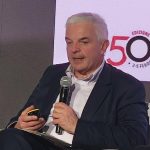
Andreasus also emphasised investment in human capital – improving staff training and skills – as well as the digitalisation of processes, not merely for marketing visibility but as a tool for real operational efficiency. Other key priorities include precise market segmentation to deliver tailored experiences, stronger destination marketing in collaboration with local stakeholders, service innovation aligned with emerging trends such as glamping, rigorous environmental sustainability management, optimisation of online distribution to reduce dependence on third-party platforms, and systematic monitoring of customer satisfaction to guide future investment decisions.
“It is essential that businesses shift from purely intuitive management to data-driven planning,” Andreasus noted. “Detailed cost and profitability analysis across each segment is the indispensable starting point for setting clear strategic goals. We must professionalise human capital and adopt digital processes that go beyond appearance and genuinely improve operational performance”.
Open-air tourism: a strategic pillar for Trentino

Closing the conference, Roberto Failoni, Tourism Councillor for the Autonomous Province of Trento, underlined the strategic importance of the sector. “Open-air tourism is a fundamental pillar of our territorial economy,” he said. “It is an exceptionally dynamic industry that continues to grow and invest year after year, demonstrating a capacity for adaptation and innovation that places it at the forefront of hospitality both in Trentino and nationwide”.


The RV Industry Association commemorates Jackie Walorski, representative of the US Congress