

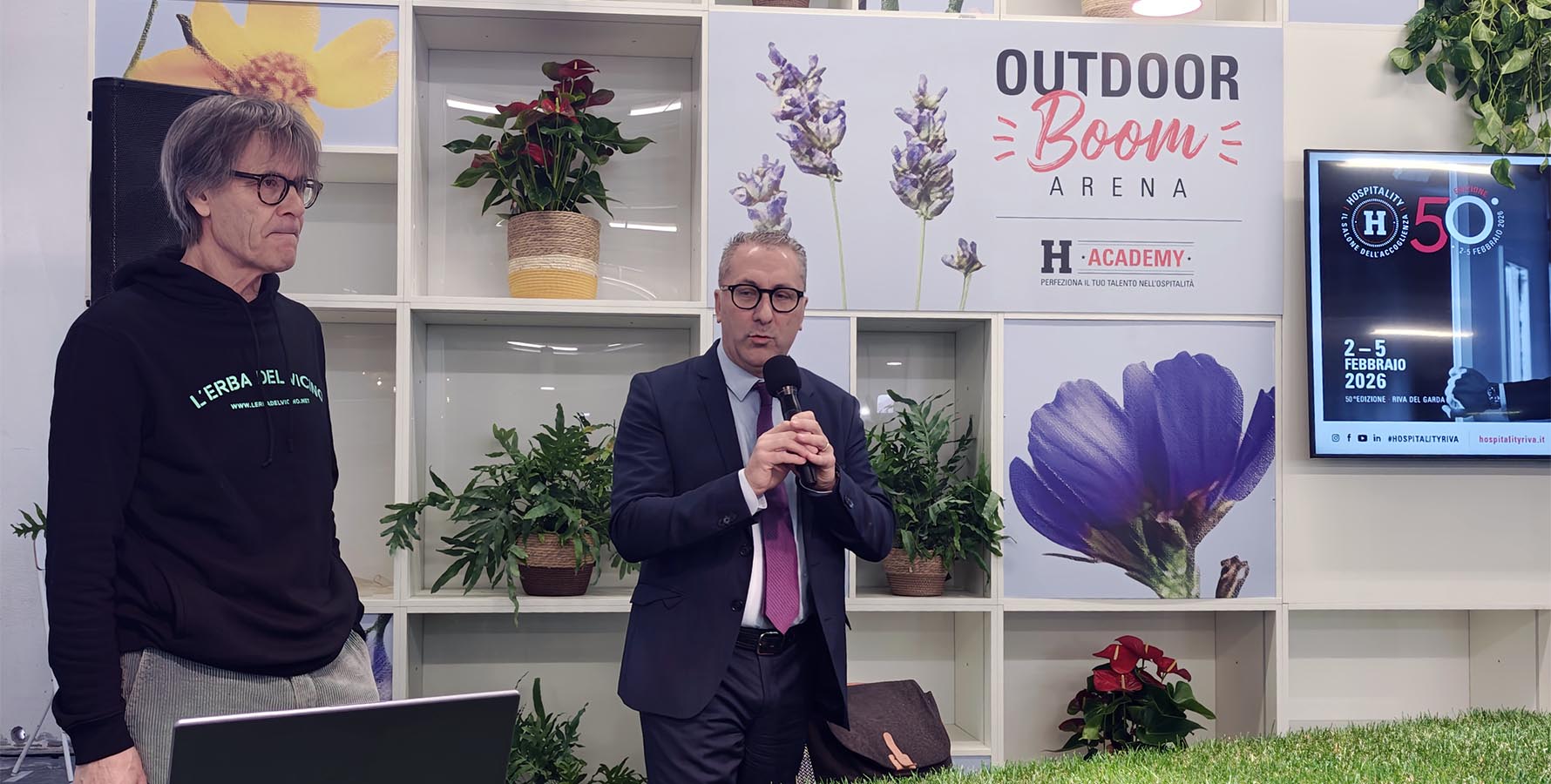

On the occasion of Hospitality – Il Salone dell’Accoglienza, FAITA Federcamping organised a meeting dedicated to sustainable green management as a strategic lever for quality, competitiveness and environmental value. The event, entitled “Sustainable Green Management in Campsites: From Operational Cost to Value Lever”, featured the intervention of landscape gardener Cleto Matteotti, a lecturer at the San Michele Agricultural School and engaged in training new technical figures in the sector.
Matteotti emphasised how, in many European countries – particularly Germany and the United Kingdom – the quality of green spaces is considered fundamental both in private areas and in urban environments, and how this awareness directly influences tourist choices. A German study shows that for 86% of tourists, attention to the environment is a determining factor when choosing accommodation, surpassing logistics, services and digital connectivity. This data challenges the widespread idea that overtourism automatically guarantees high flows: investing in environmental quality is one of the main levers to make facilities truly future-proof.
Research conducted in Croatia also highlights a correlation between the aesthetics of the campsite, guest satisfaction and their propensity to adopt sustainable behaviours. The more the environment appears well-kept and oriented towards environmental protection, the greater the attention of tourists to rules and good practices.
Green as built landscape
Green spaces in campsites are not natural environments, but a built landscape that requires constant and conscious maintenance to withstand foot traffic and soil compaction. In this context, trees and lawns become fundamental elements. Lawns, often neglected, play a crucial biological role, maintaining the soil microbiome, promoting permeability and providing oxygen to the roots. When soil becomes compacted, root growth slows and soil vitality decreases.
Matteotti explained how to apply regenerative agriculture principles to campsites: minimise soil disturbance, keep roots active, ensure continuous vegetation cover, encourage biodiversity and properly integrate organic components. Soil regeneration should be carried out with delicate techniques that do not damage the lawn, intervening between seasons with targeted sowing of resilient, low-maintenance species.
Designing new campsites offers the opportunity to adopt rustic plants with root systems compatible with the lawn and contained foliage, reducing maintenance interventions and soil stress. During the season, continuous maintenance is essential: leaf collection, targeted organic fertilisation, frequent mowing with sharp blades, and the use of electric, quiet, eco-friendly equipment allow the creation of a welcoming and sustainable environment for guests.
Green as a lever for sustainable behaviour
Matteotti highlighted how a campsite well-maintained in terms of green spaces not only improves the guest experience, but also stimulates sustainable behaviours: a lush lawn and well-kept pitches encourage visitors to respect environmental rules, from waste sorting to respecting vegetation.
The meeting emphasised that green is no longer just an operational cost, but a true strategic infrastructure, capable of increasing guest satisfaction, strengthening environmental reputation, and making facilities resilient and competitive in the long term.



WTTC: 280 billion euros lost between the US and 4 European countries due to the pandemic