


Digitalisation, integration and flexibility: these are the key words defining Camping.care’s expansion strategy across the European market, and particularly in Italy. The company, already well established in Northern Europe with more than 700 active clients, is completing its regulatory and operational adaptation process in order to position itself in a structured way within the Italian campsite sector, with the goal of being fully ready for the autumn decision-making season, when many businesses evaluate whether to change their PMS.
Leading the development of the Italian market is Vincenzo Gentile, a professional with extensive experience in organised tourism and the open-air hospitality sector, gained first with TUI, then for more than thirteen years with Vacansoleil, and later with Sandaya. His direct knowledge of the industry’s dynamics now represents significant added value in the introduction of Camping.care to Italy.
A PMS created for campsites, not adapted from hotels

One of Camping.care’s distinguishing features is its origin: this is not hotel software adapted to the outdoor hospitality world, but a platform developed from the very beginning to meet the specific needs of campsites. “For years,” explains Gentile, “I heard campsite owners complaining about outdated PMS systems, poor performance, or solutions designed mainly for hotels. Camping.care comes from a completely different vision: it is a product built around the real needs of campsites”.
The software has been developed by professionals with direct knowledge of the open-air hospitality sector, and this translates into an operational structure that is far more aligned with the day-to-day workflows of campsites, holiday parks and motorhome stopover areas.
One of the main strengths of the solution is its all-in-one approach. Camping.care combines PMS, booking engine and channel manager within a single ecosystem, avoiding the fragmentation that still characterises many hospitality businesses today.
It is not uncommon to find campsites using a PMS from one provider and a booking engine from another, resulting in management complexity, operational misalignment and additional costs. Camping.care’s goal is to overcome this limitation by offering an integrated system in which all modules communicate natively with each other. The result is smoother booking management, greater operational efficiency and lower costs associated with separate software systems or complex interfaces.
Cloud-native: accessibility and control from anywhere
Another central feature is its fully cloud-based architecture. No local installation, no internal servers to manage: the system can be accessed from computers, tablets or smartphones, wherever the user may be. For operators, this means being able to manage their business remotely, monitor booking performance, intervene quickly in daily operations and work with far greater flexibility. Cloud infrastructure also provides advantages in terms of updates, security and operational continuity, while reducing infrastructure costs compared with traditional systems.
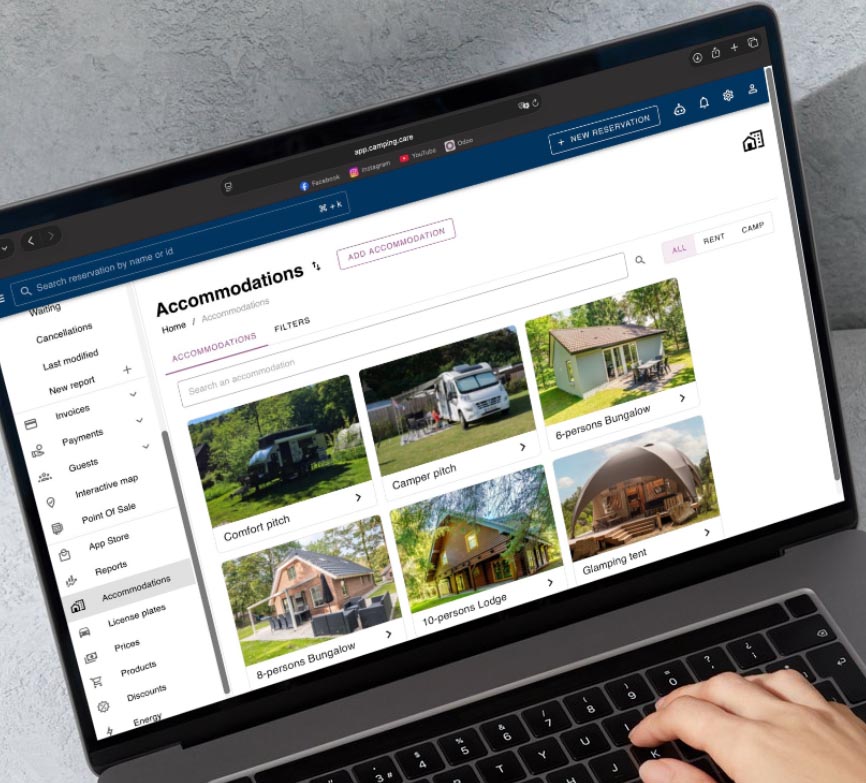
Camping.care’s philosophy is similar to that of a smartphone: the core system is complete, but each business can customise it according to its own needs. The booking engine, for example, can be heavily tailored both graphically and in terms of user experience, allowing campsites to maintain a distinctive identity and improve conversion performance.
This is supported by an integrated App Store that further expands functionality: from connections with OTAs such as Booking.com, Airbnb, Pitchup and PiNCAMP, to revenue management software, access control systems, barrier automation and many other integrations. Around one hundred connected channels are available, alongside the possibility of integrating software already used by the property, ensuring operational continuity and protecting existing investments.
Adapting to the Italian market
To operate effectively in Italy, the main focus is the digitalisation of regulatory and administrative processes: ISTAT reporting, Alloggiati Web, tourist tax management and other compliance requirements that define the national context. The goal is not simply to allow these obligations to be managed, but to automate them as much as possible, reducing manual steps and minimising the risk of error. This process is now at an advanced stage and represents one of the most strategically important aspects of the company’s Italian launch.
With about 2,500 campsites and still a relatively limited presence of large groups compared with other European countries, Italy represents a particularly attractive market for Camping.care. The fragmentation of the sector creates significant opportunities for both independent operators and organised groups. The platform is designed to adapt equally well to single campsites, multi-site networks and large groups.
Among its international clients are important organisations such as TCS Camping in Switzerland and Orbitur in Portugal, confirming the system’s ability to manage complex multi-site operations.
Migration is no longer an obstacle
One of the most common concerns when changing PMS is data migration and transition times. Here too, the cloud model simplifies the process. According to Gentile, with a decision made in autumn, a campsite can be fully operational with the new system by the end of the year, thanks to streamlined migration procedures managed entirely remotely. This is a crucial advantage at a time when many operators are looking for more efficient tools without wanting to face long periods of disruption or technical complexity.
Camping.care therefore arrives on the Italian market with a clear proposition: offering campsites software genuinely built for the outdoor hospitality sector – integrated, flexible and ready to support business growth. Digitalisation is no longer a choice, but a competitive necessity. The ability to simplify daily processes and improve operational profitability has become a decisive factor.


In Germany, Truma and Camping.info launch a petition to ask for the reopening of the campsites