

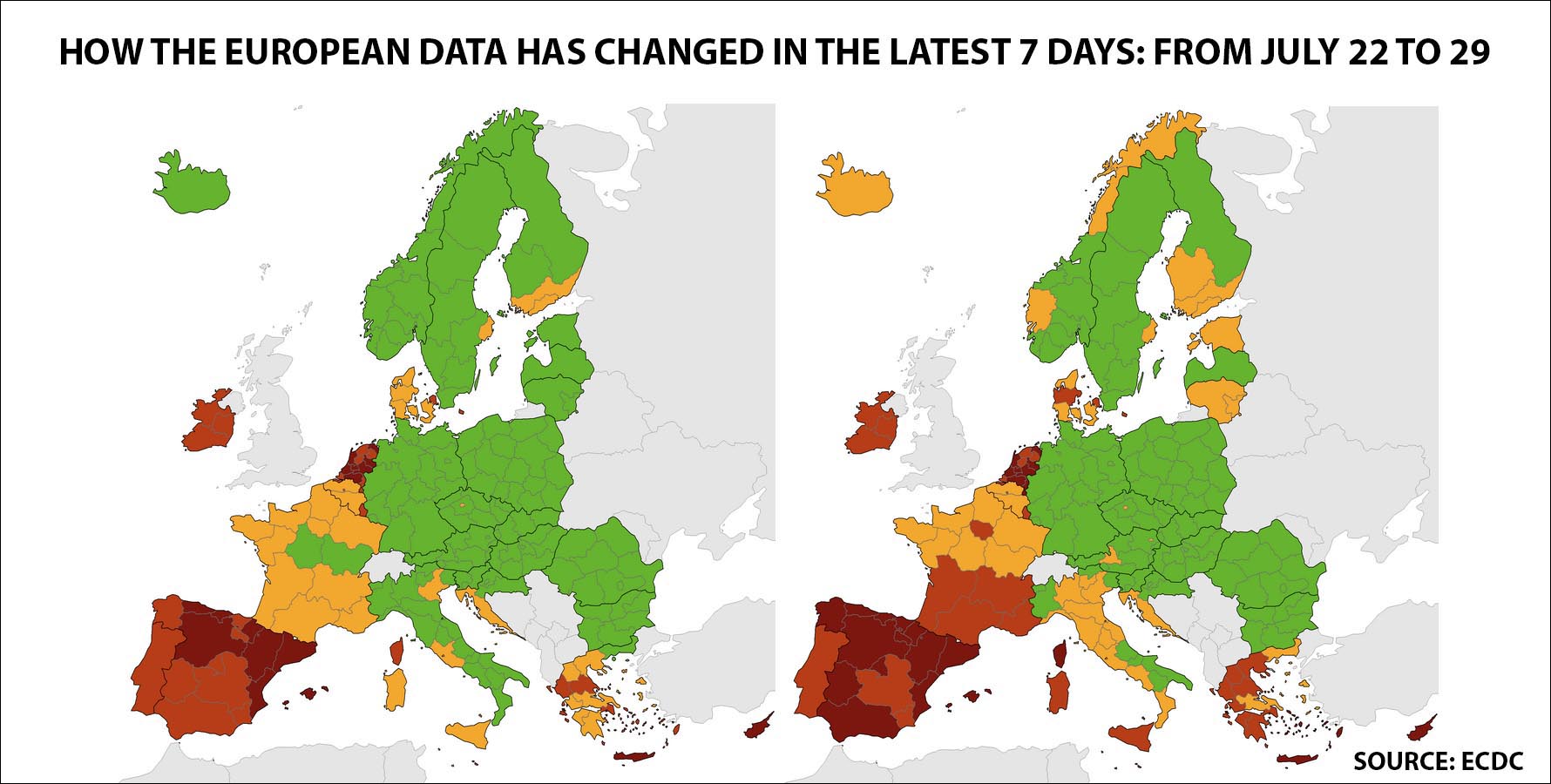

Summer is at its peak and the “vacationers” are evaluating, if they have not already done so, the period and the destination. Stay at home or choose a destination abroad? It is important, for the final decision, to know the situation of the Covid-19 pandemic both at national and European level. This is where the update on the progress of the tests and the positivity rate per 100,000 inhabitants comes in handy, published every 14 days on the website of the ECDC – European Center for Disease Prevention and Control, an agency of the European Union.
The latest ECDC data, updated as of July 29, show a notable deterioration especially with regard to Italy, France and Greece. Holland and Ireland further increased a situation that was already critical in the previous survey.
Starting from Italy, it can be seen that Sicily and Sardinia, first in the orange area, have now become red areas. The ECDC identifies with this color the areas in which the number of positive cases detected varies from 75 to 200 per 100,000 inhabitants and the positivity rate is 4% or higher, or if the first data is higher than 200, but lower than 500. Furthermore, two weeks ago Italy was almost all green apart from the two islands, Lazio and Veneto. On July 29, however, the map was tinged with orange, with the exception of the Aosta Valley, Piedmont, Abruzzo, Puglia and Basilicata.
The southern part of Greece and that of France are now red areas, as are Ireland and a third of Holland and Spain. The latter two countries are the worst-off EU states. 14 days ago they were predominantly “red areas”, but now they have changed to dark red. This means that the cumulative number of positive cases from Covid-19 is equal to or greater than 500 per 100,000 inhabitants.



Croatia, May 7 and 8 – Two days to discover career opportunities in the camping sector