
The National Federation of Outdoor Hospitality (FNHPA) presented the annual report for the 2023 season. Visitors to French campsites increased by 4.4% compared to 2022 and by 9.3% compared to 2019, totaling 141 million overnight stays recorded in 2023, a result that satisfies Nicolas Dayot, FNHPA president, who believes the sector is still benefiting from the positive post-Covid effect.
Several interesting indications emerge from the document presented by FNHPA. Firstly, it confirms that coastal campsites remain the most popular for outdoor holidays, accounting for 56% of the total annual overnight stays, with a 2.6% increase compared to 2022.
Camping pitches for tents and caravans are also experiencing a very favorable moment, with a 2.5% increasecompared to 2022. This choice is probably driven by economic reasons, commented Dayot, at a time when travelers have seen their purchasing power reduced due to inflation and general tariff increases.
Regarding accommodation preferences, however, the current trend favors 4- and 5-star campsites (which represent nearly 21% of campsites in France), as they are the fastest-growing among lodging facilities, with a 6% increase in overnight stays in the third quarter of 2023. Conversely, unclassified or 1- to 2-star campsites (40% of French campsites) experienced a decline in the number of overnight stays. With the closure of the 2023 season, attention now turns to the current season, for which prospects are promising, as April bookings increased by 6% compared to the same period last year.
The positive image of the campsite is reinforced
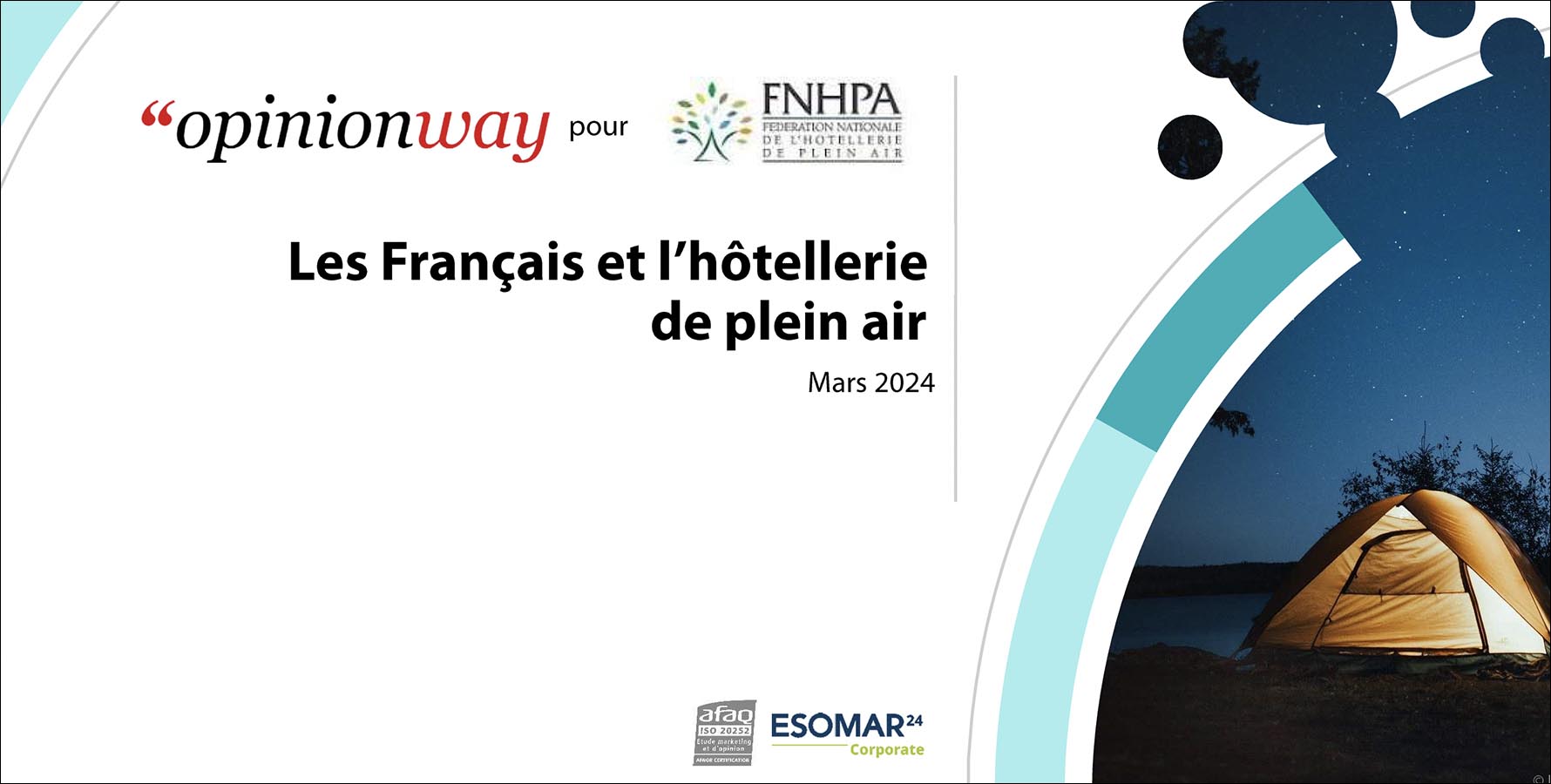
The presentation of the 2023 season report was also an opportunity for FNHPA to present the study “French People and the Open Air Hospitality Industry,” commissioned to Opinion Way. 7 out of 10 French respondents declared a positive perception of camping holidays. For them, it is a convivial and ecological way to spend vacations, but above all, economical, allowing even those facing financial difficulties to travel. The value-for-money ratio is the main criterion for those booking an outdoor stay (46% of respondents), followed by proximity to nature (27%) and conviviality (23%).
Despite the challenging economic conditions, camping seems to adapt better than other types of accommodation to consumers’ new needs, thus increasing its appeal to travelers. For instance, despite an 11% increase in pitch pricesover the last 4 years, FNHPA considers it to be lower than the 13% inflation measured over the same period, while the 18% increase in rental house prices is justified by the luxury nature of the accommodations.
Sustainability, the great challenge of the future
Lastly, a look into the future and the challenges the sector faces, primarily environmental ones. FNHPA has long been committed to this front, urging members to invest in ecological transition. The Sustainable Development Trophiesorganized by the Federation for three years are a concrete example of the desire to reward and promote the best green practices implemented by French campsite managers.
Attention has also focused on two other very important points: the need to design more sustainable accommodations, with a longer life cycle (already, the average lifespan of these structures has increased from 12 to 18 years, but more work is needed in this direction), and the need to reduce water consumption. From this perspective, FNHPA has estimated a potential saving margin of 6 million cubic meters of water per season, enough to reduce campsites’ current average consumption from 200 to 100 liters per person. The commitment is therefore to continue on the path taken.
Nicolas Dayot’s call to join the 2024 Tourism Observatory
Recently, in an interview with the French magazine L’Officiel des terrains de camping, Nicolas Dayot also drew attention to the 2024 Tourism Observatory, appealing to campsite owners to join in large numbers. The FNHPA president emphasized the dual importance of their participation in this tool: on the one hand, the statistical data provided by the barometer is a valuable aid in guiding open-air managers in organizational and marketing choices, and on the other hand, the massive participation of campsites in the Tourism Observatory contributes to giving credibility to the sector and giving it more weight in dialogue with public institutions and authorities.
Certainly, a sector capable of producing data, highlighting its economic importance, and showing its responsiveness to changes is a sector that can play a significant role in the political debate on tourism. This is the aim of FNHPA, inviting all open-air facilities (including the 1,400 participants from last year) to register massively on the website www.barometrehpa.fr.
The data collected anonymously by the platform concern booking status based on the campsite’s size, star rating, and region, as well as the origin of the clientele, but data on family size, length of stays, and overnight stays can also be collected. Financial data are excluded.
Their processing is entrusted to Atout France and FTO, which will produce a report on a weekly basis. Obviously, the more campsites register, the more relevant the results will become, and the statistics will be reliable.