



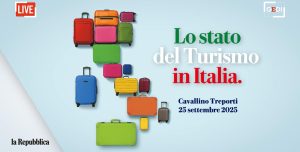
Cavallino Treporti, widely regarded as Europe’s capital of open-air holidays, recently hosted “The State of Tourism in Italy”, an event promoted by la Repubblica. It was a full day of debate and networking that brought together ministers, MPs, local administrators and leading figures from the outdoor hospitality sector. At the heart of the discussion was the open-air model – the beating heart of this Venetian destination – and the strategies needed to make tourism more sustainable, more widely spread and of higher quality.
On the political side, the debate included contributions from Gianluca Caramanna, adviser to the Minister for Tourism (Fratelli d’Italia); Alessandra Priante, President of ENIT; Carlo De Romanis, Forza Italia’s national tourism lead; Angelo Bonelli, co-spokesperson for the Greens; Antonio Misiani, economic policy chief for the Democratic Party; and Senator Raffaella Paita of Italia Viva.

Moderated by journalist Giuseppe Colombo, the panel revealed both shared concerns and clear differences over crucial issues such as sustainability, beach concessions and infrastructure. “Tourism hasn’t changed; the tourist has,” Priante noted. “People no longer travel for a destination but for a motivation”.
Caramanna defended the open-air model as “a form of tourism that, post-Covid, has seen arrivals and overnight stays increase” and highlighted public funding for new camper areas. Bonelli urged policymakers not to forget domestic travellers “penalised by rising prices on beaches and services” and called for greater investment in sustainable mobility in the South. De Romanis warned against “denaturing our beaches” through tenders favouring multinationals. Misiani stressed the importance of workers in the sector, while Paita pointed to “the loss of purchasing power among the middle classes” and the need for a genuine national tourism strategy.
Cities of art and maritime communities
The focus then shifted to the country’s art cities and coastal communities, with three mayors representing very different tourism models: Sara Funaro of Florence, Gaetano Manfredi of Naples (who also chairs the National Association of Italian Municipalities, ANCI) and Roberta Nesto of Cavallino Treporti.
Funaro highlighted the pressures on Florence, a UNESCO city of 360,000 residents but over 15 million visitors a year. “We have 8,000 social housing units and 16,000 short-let flats: we need a brake if we’re to preserve the historic centre as a living space and an identity,” she said, recalling measures on short-term rentals, urban decorum, restrictions on food outlets and on “keyboxes” within the UNESCO area to protect residents and heritage.
Manfredi described how tourism in Naples has grown at an unprecedented pace. “Tourism is a great resource but it must be regulated. Otherwise we risk conflicts between residents and visitors, as happened in Barcelona,” he warned, citing the city’s measures to limit short lets in the most congested areas and its moratorium on new food and drink licences in the historic centre, adopted “together with the traders’ association” to ease pressure.

Nesto shifted the conversation to marine communities, calling for legislative recognition to give coastal towns specific tools to manage flows and services. “Cavallino Treporti has 13,200 residents in winter but welcomes up to 120,000 in summer. Our tourism pressure index is higher than Rome’s. If we want a balance between residents and guests, we need adequate infrastructure and real powers to manage the flows,” she said.
Manfredi called this “a very intelligent idea” and confirmed that ANCI is working to give mayors differentiated regulatory powers: “This is not a left–right issue. Without the right tools, an unregulated process can become a wrong process”.
Open-air tourism as the spearhead of Italian tourism
The session dedicated to open-air tourism – moderated by Jessica Muller Castagliuolo – underlined Cavallino Treporti’s status as a European trailblazer in this field, both in visitor numbers and in the quality and breadth of its offer. Speakers included Alberto Granzotto, President of FAITA-Federcamping; Marina Lalli, President of Federturismo Confindustria; Massimiliano Schiavon, President of Federalberghi Veneto and national Vice-President; and Franco Gattinoni, President of the Federation of Organised Tourism within Confcommercio.
Lalli reported encouraging figures: “July and August exceeded even the extraordinary results of 2023, up by seven per cent. But the most important result is extending the season and spreading visitor flows”. Schiavon urged realism, pointing to the 630,000 non-hotel apartments now counted thanks to a new identification code: “Statistics now capture a much larger and more varied market”. Gattinoni set out four levers for growth – genuine on-the-job training and resources to retain staff year-round, digitalisation, fair taxation and efficient transport to plan supply. “Without these pillars, we cannot talk about quality,” he said.

Granzotto emphasised the link between environment and entrepreneurship: “An open-air holiday is about nature, experience and sustainability. If the entrepreneur does not truly believe in the environment, it won’t last”. He cited FAITA projects on the circular economy and end-of-life management for mobile homes, while highlighting the need for adequate infrastructure for a style of travel built around large self-contained vehicles.
The discussion made clear that neither the public nor the private sector can succeed alone. “On its own the private sector can do little, and the public sector can do little. We need balance and synergy,” said Mayor Nesto, echoing the views of the operators present. Cavallino Treporti was repeatedly held up as an example of excellence in hospitality and holiday quality, with enormous potential still to be unlocked for the whole country. “The customer who chooses an open-air holiday seeks nature and authenticity,” Granzotto added. “It’s up to us – entrepreneurs and administrators together – to ensure our destinations remain vibrant and welcoming for residents and tourists alike”.

Transport and intermodality: infrastructure for managing flows
Transport and intermodality were another key theme. Alessandro Vannini Scatoli, President of FS Treni Turistici Italiani; Monica Scarpa, CEO of the SAVE Group (which manages the airports of Venice, Treviso, Verona, Brescia, and Charleroi); and Deputy Minister for Infrastructure and Transport Edoardo Rixi explored how to improve access.
Scatoli outlined the experience of the new FS company, founded in 2023, which in 2024 carried 40,000 passengers on 600 historic and tourist trains. “Ours is a slow form of tourism but quick in its decisions: stepping onto the first rung of the carriage is already part of the experience,” he said, explaining how intermodality and customisation – from panoramic carriages to bike wagons – can extend the season and channel visitors to less-travelled areas.
Scarpa reminded delegates that each airplane passenger generates €90–100 of GDP: “But we lack aircraft and pilots, routes have lengthened and prices are rising. We need planning and dialogue with local areas to remain competitive”. She noted that 40 per cent of passengers arriving in Venice go on to other parts of Veneto and Italy, underlining the airport’s role as a national gateway and the importance of rail connections.
Rixi reframed the debate: “I’m not talking about overtourism in four per cent of the territory but undertourism in the other 96 per cent. We must open new areas and connect ports, airports and high-speed rail”. He outlined the investment plan through to 2032 to modernise rail and motorway networks and link airports directly to the high-speed network.

Energy: resilient networks and energy communities
Energy also featured in the closing panel. Filippo Nicolò Rodriguez, Head of Institutional Affairs for Enel Italia’s Northern Macroarea, explained that household energy costs in Italy are broadly in line with the European average and set out the tools to lower them further for businesses and SMEs – investment in renewables and storage, long-term contracts and stronger grids.
“Networks are the enabler of the transition. Installing renewables is not enough: we need the capacity to integrate new producers, resilience to climate and cyber shocks, and digitalisation to anticipate and manage emergencies”. He described renewable energy communities as a democratic tool to cut costs and emissions and, at the same time, an opportunity for “industrial tourism”: “Our infrastructure can become a stage for cycle tourism, marathons, school visits. It’s a way to tell the story of the transition and develop local areas”.
Cavallino Treporti as a model
What emerged in Cavallino Treporti is that outdoor tourism is now the spearhead of Italy’s offer. Less slogan, more strategy: infrastructure and intermodality to manage flows beyond the over-visited four per cent of the territory; energy and resilient networks as allies of sustainable tourism; training, digitalisation and fair taxation to raise quality.
As Marina Lalli put it, “Extending the season and spreading visitor flows is no longer a dream but a process already underway”. And as Granzotto concluded, “The customer who chooses the open-air seeks nature and authenticity: it’s up to us to guarantee them”.


BHI invests in innovation and sustainability to shape the future of open-air hospitality